Act II · Eleven pickups later · The scale house
Who owns
the dump?
The truck does not stop at Halifax. It backs up to the tipping face and raises the box. Thirty-six tonnes of what used to be local journalism slide out. And here is the thing nobody tells you at the gate: a dump is not where things end. It is where they get sorted, baled, trucked out the back and sold.
0 The facility
A dump is a business.
Act I was the collection route. Local newsrooms closed, merged, or got hollowed out, and the truck picked up what was left. Act II is what happens to the load.
The surviving channels still have value. Somebody finances the machinery. Somebody supplies the material. Somebody decides what gets pulled out of the pile, cleaned up and put back on the shelf as news. And somebody collects when the public buys it. Four questions, one facility:
Who owns the dump? Who funds the machinery? Who supplies the material? Who benefits when the product is sold back to the public?
It is a loop: a true thing happens, gets selected, timed, framed, amplified, retired and revived, and each pass through the facility makes somebody money, access or leverage. You will meet the loop first in the case that started this whole page.
1 First sorting station
Trudeau: the closed loop
Christmas 2020. Canadians are told to stay home. Then a photo of a government jet appears on a runway in Barbados, and for six years the same eight people keep passing the same story to each other.
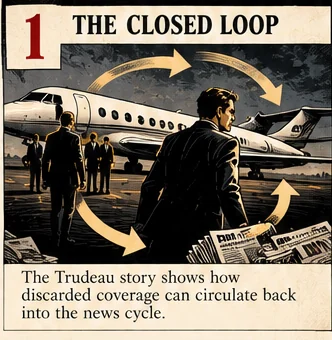
Read this as a machine, not as a scandal. The question is not “was he there?” The question is how a circle of accounts, outlets, a press office and one reporter introduce, answer, certify and revive a claim without any of them ever producing the one document that would settle it.
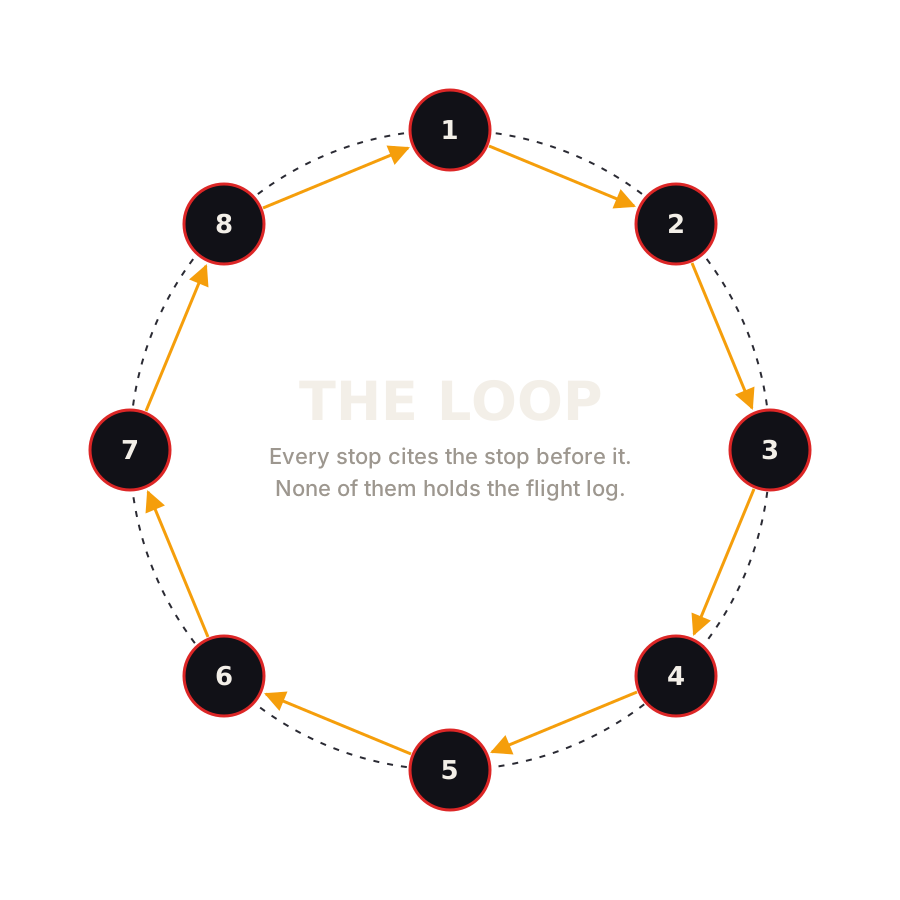
What the loop does
Stop 1 is a photo of a plane. By stop 3 it is a prime minister breaking his own rules. Stop 4 is the government denying it, which turns a rumour into a story with two sides. Stop 5 is a reporter at a Bell-owned network vouching for the denial on his own account, and from then on every fact-check cites the reporter and the press office, who are citing each other. Stop 7 finds a real jet that really went to Barbados, carrying soldiers, which is enough to restart the whole ring. Nobody in the ring is checking. The thing that would end it, the flight log, sits in a military filing cabinet and gets released years later by access request, one hundred and fifty-four pages, and still nobody in the loop reads it on air.
That is the product. Not the answer. The liability. A story that can be picked up again whenever somebody needs it, and set down again whenever somebody else does.
2 Sorting line A
Three jobs, not one villain
Every story that goes through the facility can pass through three different hands. They are separate jobs. One person can do two of them. A newsroom can do the third without ever meeting the first two.
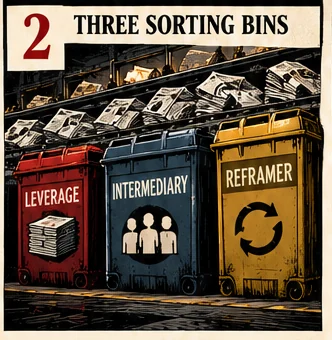
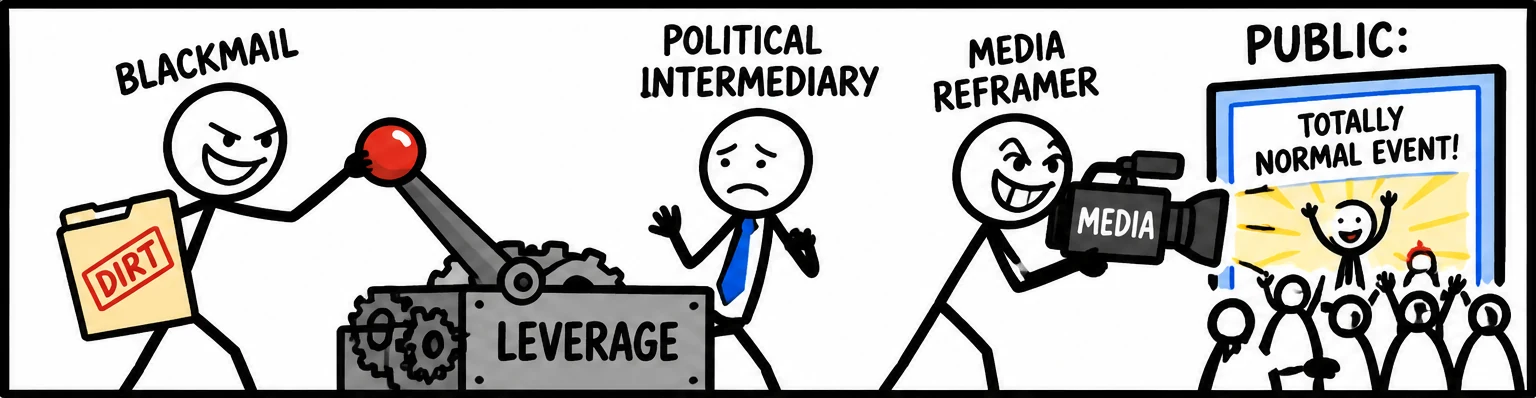
They control information that could change a political decision. The folder marked DIRT. They do not need to publish. They need the other side to know they could.
They carry the terms. Expectations, incentives, consequences. “Vote this way and the donations come. Vote the other way and this goes public.”
They change what the event means to the public, whether or not they took part in bins 1 and 2. Same event, new meaning, at exactly the moment it matters.
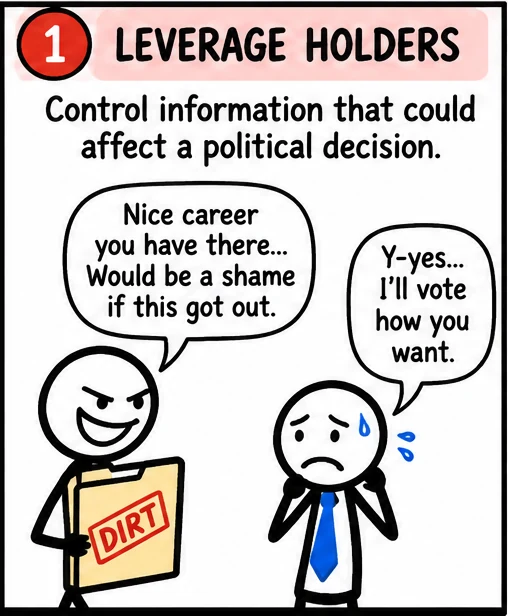
The dirt never has to be true, only credible. Its value is in staying unpublished.
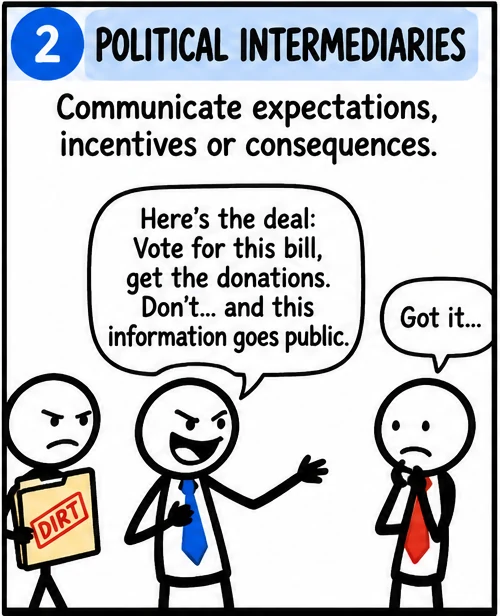
The intermediary is the one who makes the deal speakable. Lobbyist, donor, fixer, friend of a friend.
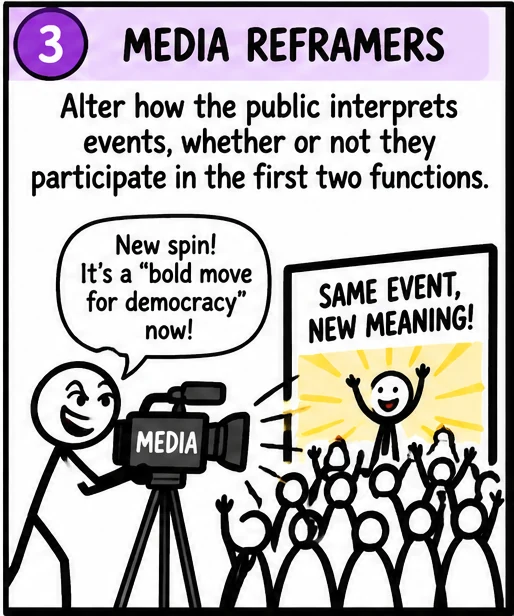
The reframer does not need the folder. It needs a deadline, a quote and a reason to run the story today instead of next month.
Keep the bins apart and you can watch it happen: a newsroom that reframes a story at a useful moment is doing bin 3 work, and it is useful to whoever holds bins 1 and 2 whether the newsroom knows it or not. The Trudeau loop was all bin 3. The next station is bin 3 with a corporate customer.
3 Sorting line B · corporate
Bell gets a free wash
A Canadian lands in Jerusalem and his phone says “Welcome to Palestine.” That is a roaming message, it has happened on carriers around the world for ten years, and it is barely news. Watch what the facility makes out of it.
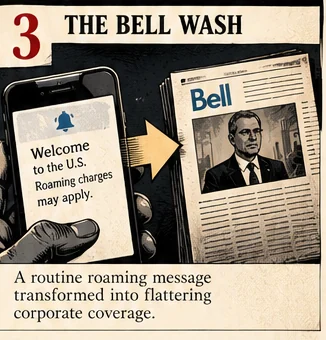

A phone displays a roaming text. That is the whole event. Nobody yet knows who wrote the word.
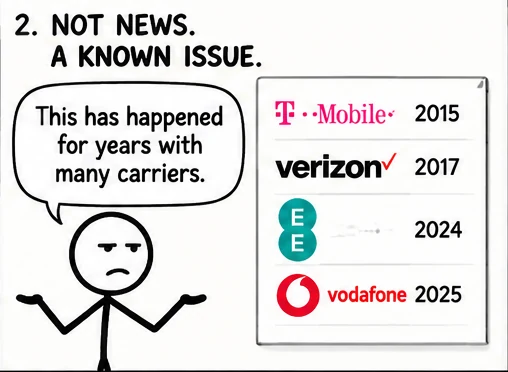
Welcome messages come from network tables, and the same word has popped up on American, British and Australian carriers for a decade. Known category, old problem.

Of all the carriers and all the years, one paper picks one Canadian carrier and makes it a story this week.
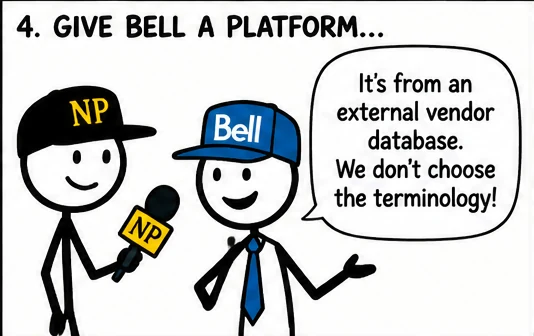
The company gets the microphone. Its explanation runs in full. The vendor goes unnamed. The follow-up question does not get asked.
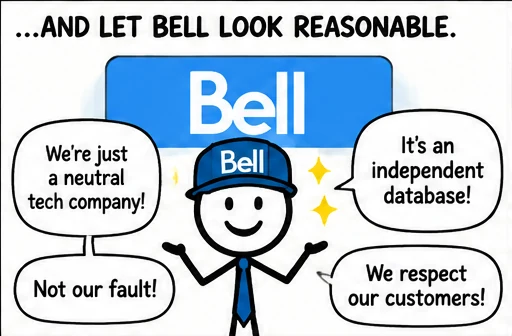
Reasonable, neutral, attentive to customers. The story about a problem becomes a story about a company handling a problem well.
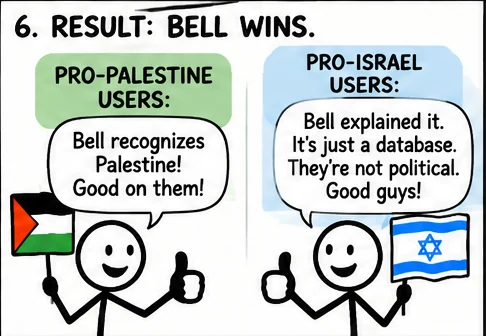
Readers who disagree about everything else both come away liking Bell, for opposite reasons.
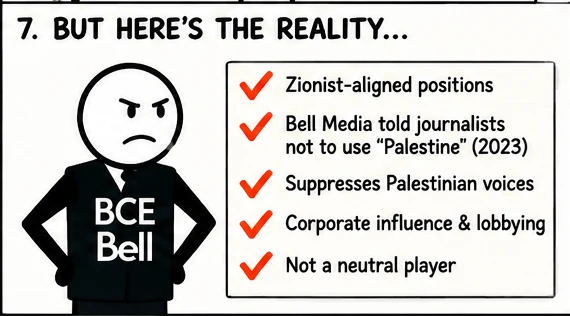
The same corporate family owns CTV, whose newsroom in October 2023 told staff not to call Palestine a country. None of that is in the article about the phone.
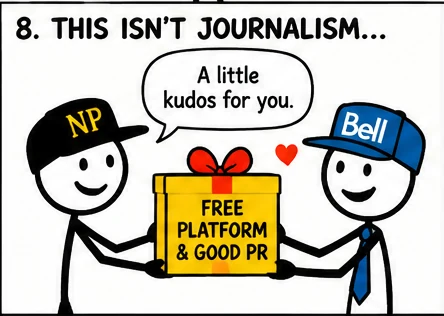
A newsroom can hand a company a reputational win without the company asking. That is the point. No order is needed.
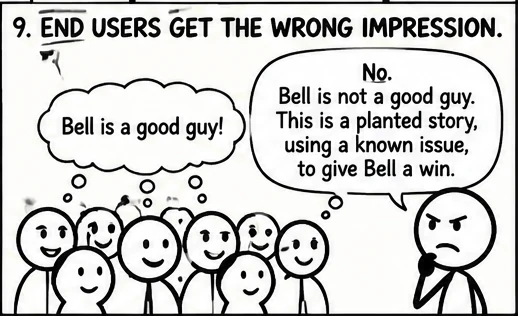
Not an explanation of who writes roaming tables. An impression of Bell.
This is bin 3 again, with a paying customer at the end of the belt. The facility took a ten-year-old technical quirk, ran it through editorial selection, gave the company the last word, and shipped out a story whose only lasting effect is how you feel about Bell. And Bell is not a bystander in Canadian news. It is one of the owners of the dump. Which is the next station.
4 Sorting line C · national security
Old loads, fresh labels
The facility keeps old material in stock. A 2012 segment about Iran gets dug up in October 2026, and the public does the sorting this time.
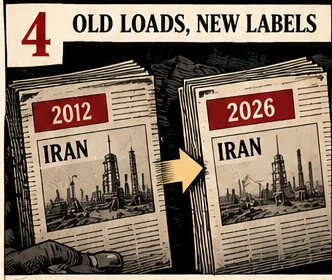
2012 · The original load
- Canada expands sanctions on Iran: frozen property, export bans.
- Netanyahu in Ottawa. Canada–Israel relations at their warmest.
- CTV: “Ottawa warns Iran.” Mercedes Stephenson reports Iran's embassy is recruiting its diaspora. National Post, same day: “Close Iran's Ottawa embassy,” quoting Nazanin Afshin-Jam, whose father was imprisoned and tortured after 1979.
- Canada closes its Tehran embassy, expels Iranian diplomats, lists Iran as a state sponsor of terror.
2026 · The public re-sorts it
- Stephenson, now the Globe and Mail's Ottawa chief, posts: Jewish community in Canada facing unprecedented threats, security officials warn.
- A reader, Tara, replies with a three-post thread: the 2012 clip, Stephenson's Fraser Institute biography (Pentagon internship, US Army Gold Coin, defence think tanks), and the 2012 National Post piece.
- The thread adds what the 2012 coverage left out: the 1953 coup, the Shah's SAVAK, decades of Western pressure on Iran before 1979.
- Fourteen years of stored material, back on the belt, with the label the public wrote.

The 2012 clip comes out of storage.

The reporter's own institutional biography, read back to her.
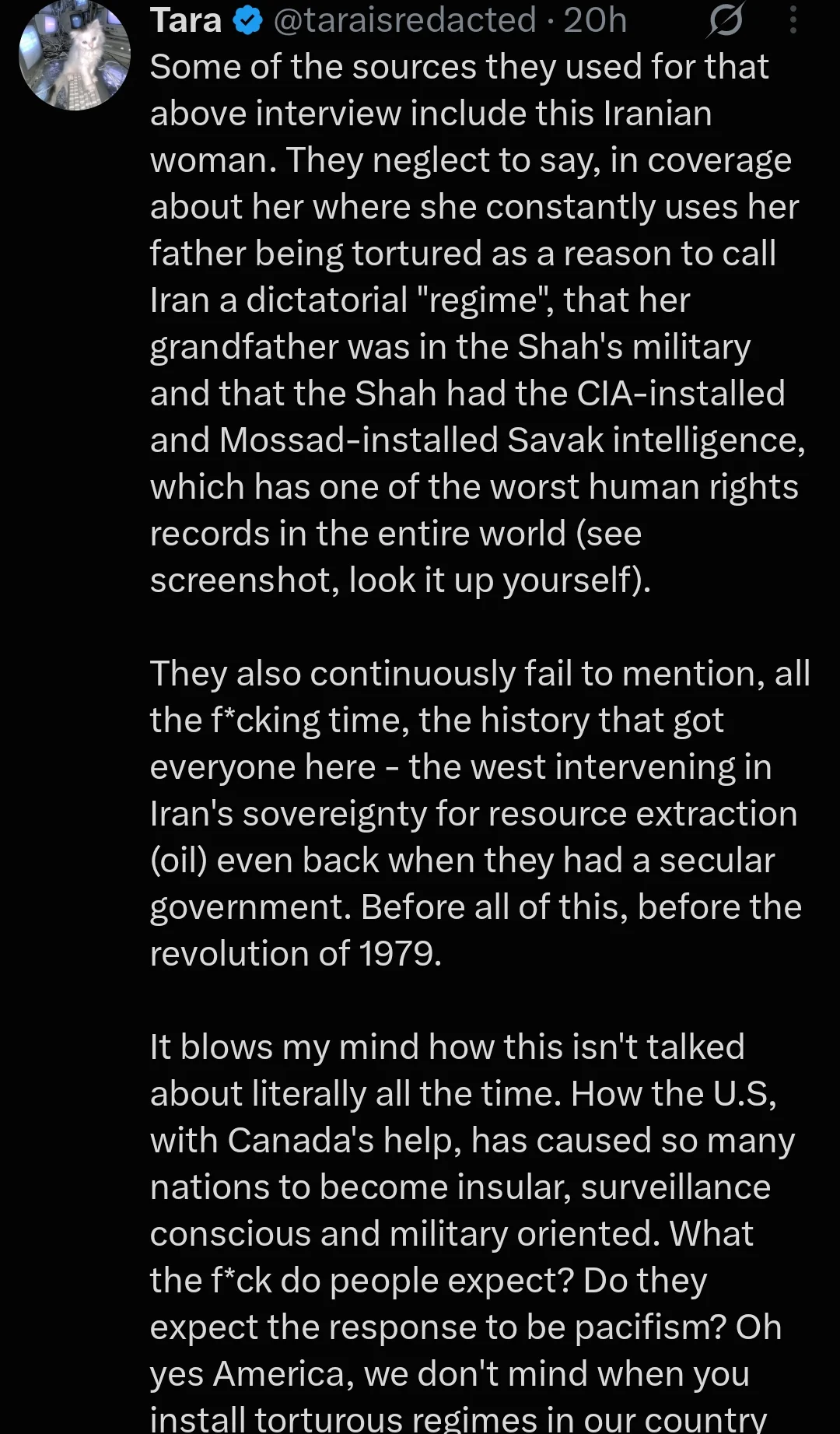
Who got the microphone in 2012, and what the segment never mentioned.
Here is the mechanism in one line: a reporter with a defence-policy résumé, a source with a personal history, an embassy story in July, a diplomatic rupture in September. In 2012 the facility packaged that as a security threat and the public bought it. In 2026 a reader unpacks the same load and finds the context that was stripped out before sale. Nothing in it needed an order. It needed a reporter whose background made the frame feel natural, an outlet that wanted the story, and a government that was already going the same way. The surplus went to the government. The reader is doing the quality control fourteen years late, for free.
5 The ledger
Who owns the dump
Not the CBC. The surviving Canadian news machine is mostly private, mostly leveraged, and the people who finance it are a short list.
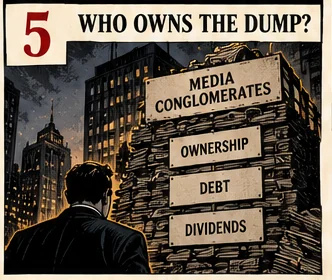
Born from the 2010 Canwest bankruptcy. Its debt was bought up by Chatham Asset Management, a New Jersey hedge fund, which has controlled the company since the 2016 restructuring. It took SaltWire's Atlantic papers in 2024. The National Post itself was founded in 1998 by Conrad Black and run from 2000 to 2010 by the Asper family's Canwest, which in 2001 ordered one national editorial a week into every paper and fired the Ottawa Citizen's publisher for printing a call for the prime minister to resign.
A phone company that owns the country's largest private broadcaster. Publicly traded. Cut 4,800 jobs in February 2024 and sold 45 radio stations, while paying out more than three billion dollars a year in dividends. Took the federal wage subsidy for its media payroll in 2020. The CTV newsroom's October 2023 instruction on the word Palestine is a Bell Media document.
Controlled by the Shaw family through voting shares. Carrying more debt than it can service, it moved western local newscasts to Toronto in 2026. Local news produced three thousand kilometres from the story.
Bought in 2020 by Jordan Bitove and Paul Rivett. The Metroland community chain went into bankruptcy in 2023: seventy papers, six hundred jobs. The two owners then fought each other in court for control.
The Thomson family's holding company. The richest family in Canada owns the paper of record outright. Stephenson's current employer.
Pierre Karl Péladeau's company, and a former Parti Québécois leader's. The French-language ecosystem held up better in Act I partly because this owner still lives where the readers do.
The other phone company. Family-controlled, and the family fought in court for the board in 2021.
Subscription and donor funded. They are the ones who keep the Trudeau loop turning: Western Standard ran the Barbados jet, Rebel filed the access request. They need the loop as much as the loop needs them.
Who funds the machinery
Three sources of money run the belts. Debt, which is why Postmedia and Corus cut everything that is not a brand. Dividends, which is why Bell cuts newsrooms in a year it raises the payout. And the federal government, through the journalism labour tax credit, the wage subsidy during COVID and the Google settlement under the Online News Act, a hundred million dollars a year split among the survivors. The same government the surviving newsrooms are supposed to be watching now subsidizes their payroll. That is the “reporter on the payroll” problem, and it has nothing to do with any single reporter.
Who supplies the material, and who gets access
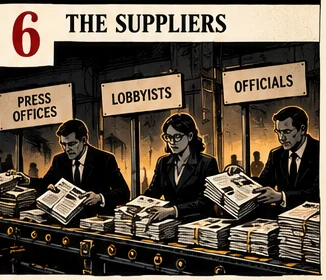
Sources supply the material. In Ottawa that means press offices, ministers' staff, security officials who warn, and the organized lobbies that have the registrations, the sponsored trips and the phone numbers. The Centre for Israel and Jewish Affairs is a registered federal lobbyist and the official advocacy arm of Canada's Jewish federations; it sponsors parliamentary travel to Israel and runs sustained campaigns on how newsrooms cover the region.. When a story needs a security frame, an expert, a victim or a quote on a Tuesday, the organized suppliers are the ones who pick up the phone, and the organized suppliers have interests. Ownership decides which newsrooms survive. Supply decides what goes on the belt. Lobbying decides which frames are already in stock. That is the machine.
6 The packaging line
Introduce. Amplify. Retire. Revive. Reframe.
Every case on this page ran the same five-step belt. Not every story hits every step. The loop ones hit all five.
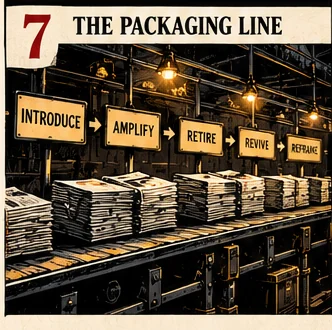
A Facebook photo of a jet. A reader's phone. A security official's warning. Something true enough to start with.
An outlet picks it up and names a target. Others cite the first outlet. The circle closes.
A denial, a fact-check, a company statement. The story is “over.” Nothing was resolved.
Years later a new document, a new crisis or a new reader brings it back, with the old frame attached.
Same event, new meaning. Bell is reasonable. Iran is a threat. Trudeau is lying or Trudeau is a victim, depending on who needs what.
The Trudeau jet went round all five and is back at step one. The Bell text was introduced, amplified and reframed inside a single article. The Iran segment was retired in 2012 and revived by the public in 2026, which is the only step on the belt the facility does not control.
7 The loading dock
What you actually got
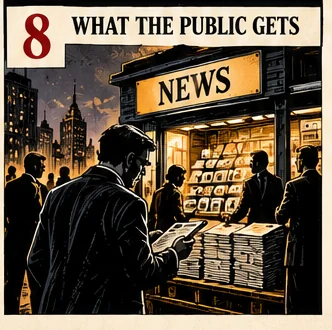
Here is what left the facility and arrived in your feed, as news.
8 The back gate
The loop pays
A dump that only buried things would go broke. This one sells.
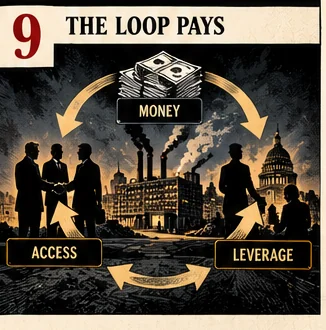
That is the whole route. Eleven cities of collapse were Act I. The dump is where the collapse becomes a business. The truck is already warming up for the next run, and the material is already waiting at the gate, because the loop has to be fed.
Who owns the dump? The people who financed it. Who supplies it? The people with the phone numbers. Who benefits? Everybody in the ring. Who pays? You did, at the gate, and again at the till.